


Planning to study or work abroad? Choosing the right English proficiency test can save you hundreds of dollars — and a lot of stress. Here is everything you need to know before you book.
The two most talked-about options right now are IELTS — the long-trusted global standard — and the Duolingo English Test (DET) — the newer, tech-powered alternative you can take from home. Both measure your English, but they are built for different situations, different budgets, and different goals.
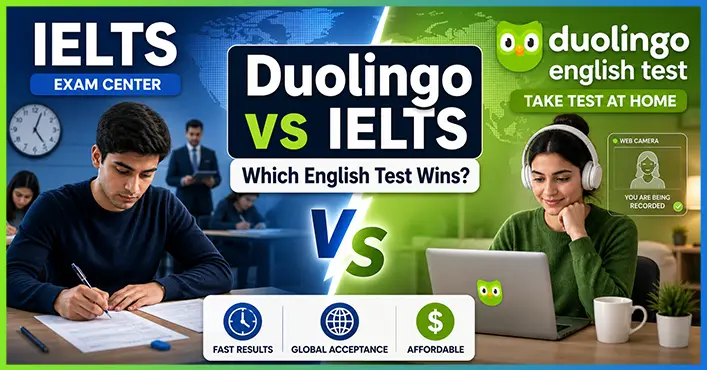
Let us break them down clearly so you can decide with confidence.
What Are These Tests, Exactly?
IELTS — The Global Gold Standard
IELTS (International English Language Testing System) has been running since 1989. It is co-owned by the British Council, IDP, and Cambridge Assessment English — names that carry serious weight worldwide. The test covers four core skills:
-
Listening
-
Reading
-
Writing
-
Speaking (face-to-face with a certified human examiner)
IELTS is accepted by almost every university, most governments, and immigration authorities in the UK, Australia, Canada, New Zealand, and beyond. It is the safe, universally accepted option.
Duolingo English Test — The Modern Challenger
The Duolingo English Test launched in 2016 and gained serious momentum during the COVID-19 pandemic when in-person testing became difficult. Key features include:
-
100% online — taken from home on your laptop
-
Results delivered within 48 hours
-
Uses adaptive technology — questions adjust in real time to your performance
-
Costs a fraction of IELTS at around $65 USD
Acceptance has grown significantly — over 5,000 institutions now recognise it — but it is not yet universal, especially for immigration and visa purposes.
Also must read if confused about IELTS vs PTE vs TOEFL
Key Differences at a Glance
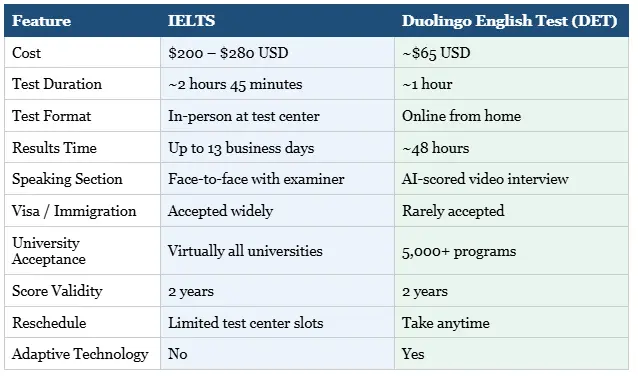
Use this table to compare both tests side by side across the most important factors:
IELTS — Pros, Cons, and Who It Is Best For
IELTS is the safer, more universally accepted choice. If your goal involves immigration, a government-regulated visa, or applying to a traditional institution, IELTS is the one to book.
Strengths of IELTS
-
Accepted by virtually all universities worldwide
-
Required for UK, Australia, Canada, and New Zealand visa applications
-
A human speaking exam builds credibility with institutions
-
Decades of institutional trust and global recognition
-
Two versions available: Academic and General Training
-
Scores accepted by employers and professional bodies globally
Limitations of IELTS
-
Costs $200–$280 USD per attempt — expensive if you need to retake
-
Requires travel to a designated test center
-
Results take up to 13 business days
-
Limited booking slots in some regions
-
Formal test environment can feel stressful for some candidates
IELTS has built 35+ years of trust with institutions — but that trust comes at a price, both financially and in terms of convenience.
Duolingo English Test — Pros, Cons, and Who It Is Best For
The Duolingo English Test is ideal if you are applying to universities that accept it, need results quickly, or are working with a tight budget. It is especially popular with international students applying to universities in the United States and Canada.
Strengths of Duolingo English Test
-
Costs around $65 USD — approximately 75% cheaper than IELTS
-
Take it from home, at any time that suits you
-
Results available in just 48 hours
-
Adaptive technology delivers a fairer, personalised score
-
Send results to unlimited institutions for free
-
No travel or scheduling at a test center required
Limitations of Duolingo English Test
-
Not accepted for most immigration and visa purposes
-
Some universities and institutions still do not recognise it
-
AI proctoring and online format raises trust concerns for some bodies
-
No in-person speaking component — may feel less authentic
-
Newer test with less institutional history compared to IELTS
Must read: LanguageCert vs IELTS Comparison
Which Test Should You Choose?
There is no single correct answer—it depends entirely on where you are applying and what you need the test for. Use this framework to decide:
| Choose IELTS if you... | Choose Duolingo if you... |
|---|---|
|
Need it for a UK, Australia, or Canada visa Are applying to traditional universities Prefer face-to-face speaking evaluations Want results accepted globally, no questions asked |
Confirmed your university accepts DET Need results quickly (within 48 hours) Are working with a tight budget Prefer the flexibility of testing from home |
Pro Tip: Some applicants take the Duolingo test first for a quick, affordable result to submit early applications—then follow up with IELTS if a shortlisted program requires it. This saves money and buys valuable time.
6. Frequently Asked Questions
Here are the most common questions people ask when comparing Duolingo and IELTS:
|
Question |
Answer
|
|---|---|
| Is Duolingo easier than IELTS? | Neither is objectively easier. It depends on your strengths — IELTS has a formal format while DET uses adaptive questions that adjust to your level. |
| Can I use DET for a UK visa? | No. UK Visas and Immigration does not accept the Duolingo English Test. IELTS for UKVI is required. |
| How many universities accept DET? | Over 5,000 programs and institutions worldwide, including many in the US, Canada, and Europe. |
| How long are scores valid? | Both IELTS and Duolingo scores are valid for 2 years from the test date. |
| Can I retake DET immediately? | You can retake DET once every 30 days, up to 3 times in a rolling 12-month period. |
Final Verdict
Neither test is universally better — they simply serve different needs.
| IELTS wins on... | Duolingo wins on... |
|---|---|
| Global acceptance, immigration credibility, institutional trust, and human speaking examiner. If access matters most, IELTS is the safer bet. | Affordability, speed, convenience, and flexibility. If your target institutions accept it, DET delivers excellent value and much less hassle. |
Before booking either test, do one thing first: visit your target institution's admissions page and confirm which tests they accept. That single step will make your decision easy.
If both are accepted, think about your timeline and budget. If cost and convenience are your priority — go Duolingo. If you need maximum acceptance with zero risk — go IELTS.
Need help deciding which test is right for your study abroad journey? Western Overseas is here to guide you every step of the way — from choosing the right English test to securing your dream university admission. Contact us today or visit Western Overseas to get expert advice tailored to your goals.


 Phone - +91- 9115017017
  WhatsApp - 9896512412
  Email - info@western-overseas.com