


IELTS stands for International English Language Testing System. It's the world's most widely taken English proficiency test—accepted by universities in the UK, USA, Canada, Australia, New Zealand, Ireland, and dozens of other countries.
If you're planning to study abroad, migrate, or work internationally, you need IELTS. And before you need a good score, you need to understand exactly how the exam works.
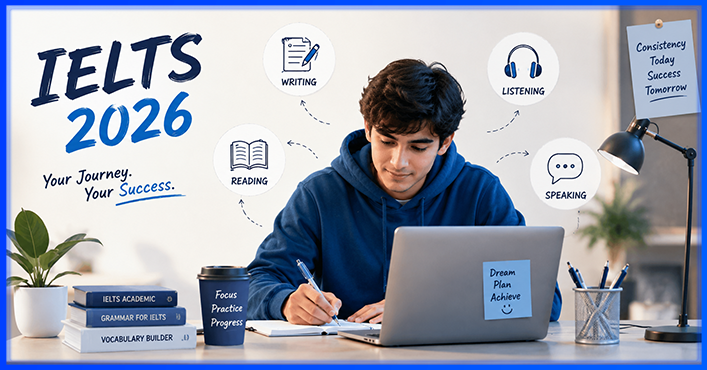
Total duration: 2 hours 45 minutes. Four sections: Writing, Reading, Listening, and Speaking. You can take the test on a computer or paper.
Here's everything, section by section.
What Is IELTS?
IELTS assesses four communicative skills of candidates: writing, reading, listening, and speaking. There are 2 versions:
-
IELTS Academic — for students applying to undergraduate or postgraduate programs
-
IELTS General Training — for work, migration, or secondary education purposes
Listening and speaking are identical in both. Reading and writing differ slightly in task type.
IELTS Exam Pattern: Quick Overview
| Section | Duration | Total Questions/Tasks |
|---|---|---|
| Listening | 30 min + 10 min transfer | 40 questions |
| Reading | 60 min | 40 questions |
| Writing | 60 min | 2 tasks |
| Speaking | 11–15 min | 3 parts |
| Total | 2 hr 45 min | — |
Writing Section
Duration: 60 minutes for both tasks combined.
Task 1 (minimum 150 words)
You're given a visual — a bar graph, line graph, pie chart, process diagram, table, or map — and asked to write a report describing it. Academic Task 1 requires data description. In 2026, mixed charts (e.g., a pie chart combined with a table) are appearing more frequently. Candidates must synthesize data across 2 visuals, not just describe one.
Word limit: 150 words minimum. Recommended time: 20 minutes.
Task 2 (minimum 250 words)
An essay prompt is given on one of several recurring topic categories:
-
Education
-
Healthcare
-
Environment
-
Economy
-
Social life & technology
You write a full argumentative or discussion essay in at least 250 words. Recommended time: 40 minutes.
Important: Task 2 carries twice the weight of Task 1 in your final Writing band score. Most test-takers lose marks here because of memorized templates. In 2026, examiners are penalising generic structures — your essay must respond to the specific question asked.
Writing is evaluated on:
-
Task Achievement / Task Response
-
Coherence & Cohesion
-
Lexical Resource
-
Grammatical Range & Accuracy
Reading Section
Duration: 60 minutes
Total questions: 40
Passages: 3 (academic texts from journals, books, newspapers, online sources)
Each passage increases in difficulty. You answer 40 questions across all 3 passages within 60 minutes — no separate transfer time. Manage your time carefully: roughly 20 minutes per passage.
Question types you'll see:
-
Gap filling (sentence or paragraph completion)
-
Matching headings
-
Matching information
-
True / False / Not Given
-
Multiple choice (MCQ)
-
Sentence ending completion
Marking scheme: Each correct answer = 1 mark. Total 40 marks, converted to a band score of 1–9.
No negative marking. Attempt every question.
Listening Section
Duration: ~30 minutes of audio + 10 minutes to transfer answers
Total questions: 40 (10 per part)
Parts: 4
Each part plays once. You cannot replay the audio.
| Part | Context |
|---|---|
| Part 1 |
Everyday social situation—a conversation between 2 people. |
| Part 2 | Everyday social situation — monologue (e.g., a guided tour) |
| Part 3 | Academic discussion — up to 4 speakers in an educational context |
| Part 4 | Academic lecture — monologue on a specialist subject |
Question types:
-
Gap filling
-
Map/diagram labelling
-
Form completion
-
Multiple choice (MCQ)
-
Matching
Marking scheme: Each correct answer = 1 mark. 40 marks total, converted to a band score.
The 10-minute transfer rule: Once the audio ends, you get 10 minutes to transfer your answers from the question booklet to the answer sheet. On computer-delivered tests, this is handled differently—you fill in answers directly during listening.
Speaking Section
Duration: 11–15 minutes
Format: Face-to-face conversation with a trained examiner (some centres now use Video Call Speaking)
Speaking is conducted separately — either on the same day as the other 3 sections, or up to 7 days before or after.
Part 1 — Introduction (4–5 minutes)
General questions about yourself: your home, family, studies, hobbies, work. The examiner is warming you up, not trying to trip you up. Speak naturally.
Part 2 — Cue Card (3–4 minutes including 1 minute prep)
You receive a topic cue card and have 1 minute to prepare notes. Then you speak for 1–2 minutes on that topic. Topics could be: a person you admire, a place you've visited, or a skill you want to learn.
Part 3 — Follow-ups (4–5 minutes)
The examiner asks abstract or analytical questions related to your Part 2 topic. This is where Band 7+ candidates separate themselves—your ability to discuss ideas, not just describe experiences, matters here.
Speaking is marked on 4 criteria:
-
Fluency & Coherence
-
Lexical Resource
-
Grammatical Range & Accuracy
-
Pronunciation
Memorised answers actively hurt your score in 2026. Examiners are trained to detect and penalize them.
IELTS Band Score: How It Works
Scores run from 0 to 9 in whole or half bands (e.g., 6.5, 7.0). Each section gets its own band score. Your overall band score is the average of all 4 sections, rounded to the nearest half band.
Most universities require a 6.0–7.0 overall, with minimum requirements per section.
There is no pass or fail in IELTS. Your score is valid for 2 years.Computer vs. Paper-Based IELTS
Both deliver the same exam, same scoring, same difficulty. The difference is delivery.
One major update in 2026: One Skill Retake — exclusive to computer-delivered IELTS. If you fall short in just one section, you can retake that section within 60 days instead of redoing the entire exam. This is already active at select British Council and IDP centers.
Quick Tips to Score Higher
Writing: Spend 3 minutes planning before you write. Ditch templates. Answer the exact question asked — not a generic version of it.
- Reading: Skim for main ideas first. Scan for specific answers. Don't read every word — extract, don't enjoy.
- Listening: Underline keywords during the 30-second preview before each part. Synonyms appear frequently — the audio almost never uses the exact words from the question.
- Speaking: Speak at a natural pace. If you make a mistake, continue — don't stop and restart. Part 3 rewards depth of thinking, not just grammatical accuracy.
Planning to take IELTS? Western Overseas has helped thousands of students crack their target band score — get expert guidance today.


 Phone - +91- 9115017017
  WhatsApp - 9896512412
  Email - info@western-overseas.com